GOLD RUSH DAYS


Prologue to 1857: The California Gold Rush

Together, Mother Nature's massive hurricane in the Atlantic, sinking the Ship of Gold, collided with a radical change in 1857 monetary policy to deliver a double blow to U.S. commerce and shock the U.S. economy. But what was going on that brought the Ship of Gold to its final resting place 160 miles east of Cape Fear, North Carolina, on the night of September 12, 1857? These events set off cascading challenges in banking as well as local, national, and international commerce.

Background Information

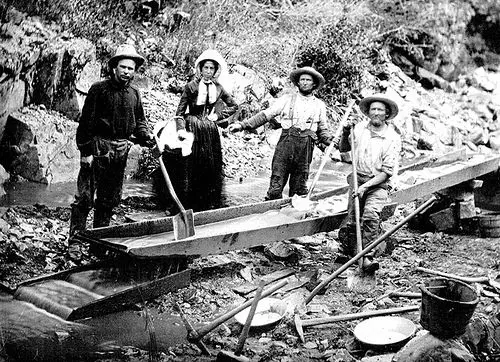
This amazing story begins in August 1848 with the announcement that gold was found in California.  However, California had just separated from Mexico and it was not a U.S. State until September 9, 1850!  There was minimal physical or legal infrastructure in place to support the needs of thousands of optimistic prospectors, essential assayers and eager merchants.  While opportunities soared, challenges existed.

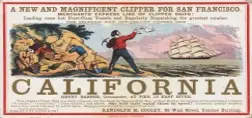
Steamships soon sailed from the East Coast loaded with merchandise and supplies to support the prospectors in their new adventure. They carried U.S. Mail and passengers.


Our Gold Rush Era Timeline:  

California Gold Rush

August 1848

U.S. Congress officially organized land into the Oregon Territory. Gold was discovered in Oregon in January 1849.
California Gold Rush

California to San Francisco
1848 to 1849

The U.S. Postal Service (USPS) supported “westward expansion” by contracting with private steamship companies to transport mail between New York City and Astoria, Oregon.   

December 1, 1848

The first Atlantic-side U.S. Mail shipment from New York City to Chagres, Panama left December 1,1848.  It was coupled with a Pacific U.S. Mail steamship contractor to collect the west-bound cargo and passengers in Panama City…after completing a rugged overland journey across the Isthmus of Panama.   (The Isthmus was transited only by wagon and mule until December 1855 when a cross-country railroad was completed.)
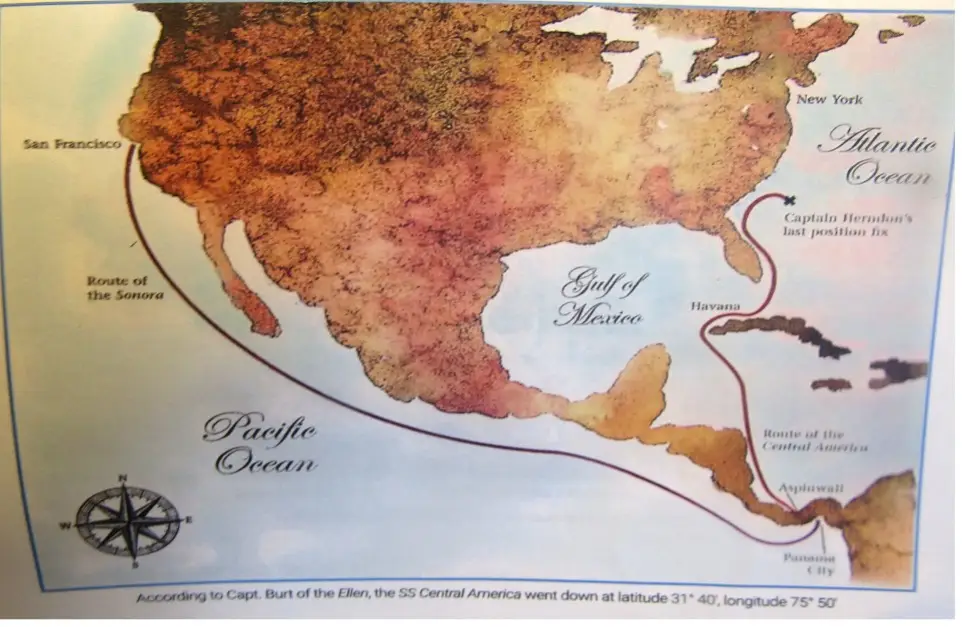
SS Central America Route
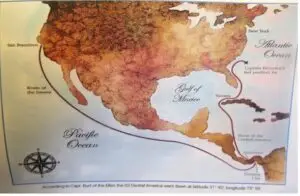
This Map shows approximately where the S.S. Central America sank in the Atlantic.

It also depicts the route for the 30-40-day journey via two steamships between New York and San Francisco  which included a crossing by land   at the Isthmus of Panama.

December 5, 1848

Back on the East Coast…President James Polk, in his public address to Congress on December 5, 1848,  affirmed an “AN ABUNDANCE OF GOLD” in California…and the Gold Rush was on!


California to San Francisco
February, 1849

The Pacific route stops included a fledgling San Francisco CA by February, 1849.  At that time, San Francisco was a village of just a few hundred residents called “Yerba Buena.”

Crossing the  Isthmus of Panama

Crossing the  Isthmus of Panama and transferring ships took far less time than traveling around South America’s Cape Horn from New York to San Francisco, a 200+ day journey!


No Transcontinental Telegraph

There was no transcontinental telegraph until 1861, so U.S. Mail was essential for communications. But U.S. Mail, passengers and cargo, going either way through Panama, may have taken up to 40-days!

However, because of the remarkable Gold Rush developments, returning vessels were now carrying U.S. Mail, passengers, plus commercial gold cargo destined for East Coast banks and government agencies.

There were U.S. Mail Steamship contractors on both the Atlantic and Pacific coats. Ships like the S.S. Central America (previously operated as the S.S. George Law) had two runs per month: by 1857, this ship had already transported over $54 million in gold!  (The value of these shipments today would be approximately 30-times the 1857 value.)

“In 43 trips between Panama and New York City between 1852 and 1857, the ship (S.S. George Law /S.S. Central America)  carried as much as a third of all the gold found during the California gold rush.” (1)

This ship’s impressive career ended as the result of a massive hurricane in the Atlantic, sinking the New York-bound ship on September 12, 1857 approximately 160 miles east of Cape Fear, N.C.  While 153  women and children were rescued, 425 men lost their lives, including the Captain, W.L. Herndon.

(1) National Museum of America History: Disaster! The Sinking of the S.S. Central America  https://americanhistory.si.edu/explore/exhibitions/on-the-water/online/maritime-nation/shipwrecks/sinking-central-america

Join Our Crew


REMEMBER…THE FINAL JOURNEY:
The 170th Anniversary of the S.S. Central America’s tragic sinking is September 12, 2027!

Remember the S.S. Central America’s final journey. Help us honor the 425 men, passengers, and crew whose lives were lost, and the 153 women and children who were rescued and whose lives were changed forever. Here is what we are considering.

  • Hosting a special remembrance event and ringing the ship’s bell
  • Producing a commemorative medal with a story card
  • Publishing new research about the passengers and crew

We are seeking sponsors, donors, and volunteers to help us plan, organize, and host a special commemoration in memory of the lives lost and those changed when the S.S. Central America sank in 1857.

Let us know if you would like to learn more.
Contact Rebecca at programs@10tumultuousyears.org

SUBSCRIBE!
We’ll keep you notified of upcoming Podcasts, Publications, Programs, Exhibits and Presentations in 2027.

Any questions? Contact Rebecca:
programs@10tumultuousyears.org

This site is under construction

Be first to know when we launch

Sign up for updates on 170th anniversary remembrance events, new exhibits and stories, commemorative coins, and the full launch of 10TumultuousYears.org.